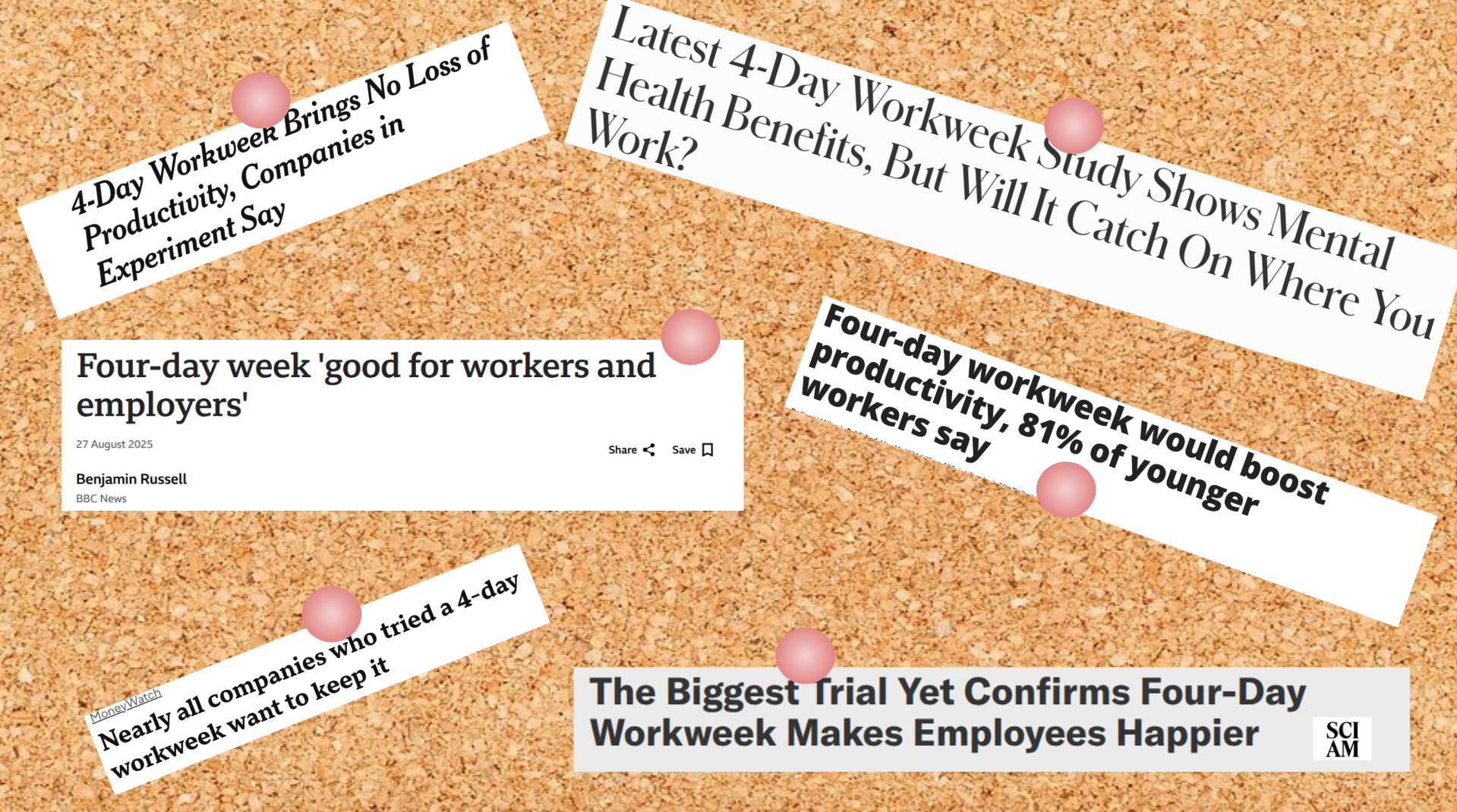
Switching to a 4-day work week would vastly benefit businesses, schools, and industries. Many companies, such as Chick-fil-a (in certain locations), the Japan branch of Microsoft, and Panasonic, have switched to a 4-day schedule because it is economically more sustainable and has proven to boost the mental health of employees.
Some might argue that a 4-day work week is simply too short. Perhaps a shorter week might not be accessible to all industries, such as healthcare, manufacturing, and service industries. Not only this, but a 4-day work week could stress people out: compressing all the work from a regular workweek into just 4 days could put pressure on employees, thus worsening their mental health.
Economic and work-life benefits
Switching to a 4-day long week would be more economically suitable than a 5-day work week. Aspen High School Superintendent Tharyn Mulberry says, “If you have one less day of operation for the school district, one less day of transportation, facilities, all those sorts of things, it saves a lot of money for the district.”
A 4-day work week provides more time flexibility for employees to run errands, go to appointments, and do other tasks not involving work.
Superintendent Tharyn Mulberry says, “For the most part, most people would really enjoy having an extra day on the weekend.” A 4-day work week means that workers would no longer have to choose between work and personal life, most time sacrificing one for the other.
Health benefits
In the UK, an experiment was held about a 4-day-long work week: in 2022, the UK switch led to a 4-day work week system for 6 months. The model was the 100-80-100 model, where employees got paid 100% of their salary, while working 80% of the time, for 100% productivity. Boston College provided a report for the experiment. In the report, the results were overwhelmingly positive. 71% of employees had reduced burnout by the end of the research period, and 39% of employees felt less stressed.
Another study found that there was almost a 25% drop in sick days, and about 18% said that their mental health was better. At the end of the trial, 91% of the businesses that participated chose to continue the 4-day work week system, proving its effectiveness and support from the workers. Overall, the health benefits of a 4-day work week are overwhelmingly positive, encouraging businesses to transition to a shorter work week.
Businesses around the world should discuss with their employers the potential benefits of a 4-day work week. For AHS, students and staff could discuss with the board a schedule for a 4-day-long week, where each school day is a little longer. Mulberry says, “For the most part, most people would really enjoy having the extra day on the weekend…I think it’s just a great idea. ”