In the Roaring Fork Valley, a destination seen by many as the epitome of luxury and affluence, many families consistently struggle to put food on the table. Food insecurity affects many valley residents, including families in ASD. Every day, 133 students enrolled in ASD receive free or reduced lunch.
Rising housing costs, higher grocery prices, and recent federal changes to assistance programs are leaving more families struggling. Since it is now harder to qualify for programs such as SNAP (which aims to alleviate hunger by providing money for groceries) and for free and reduced lunch, many families turn to local community organizations that provide food resources.
Katherine Sand, founder of Aspen Family Connections, an organization that connects local families to essential resources such as food, mental health support, and budgeting help, has worked with nonprofit organizations for thirty years. She explains her view on food insecurity.
“Food insecurity is a hidden problem in our valley,” Sand said. “Nobody wants to admit they don’t have enough food because of the stigma attached.”
Signs of this problem are visible every day within Aspen schools. Aspen Elementary School staff members report that some students come to school hungry and without money to buy lunch, prompting the teachers to have snacks at hand in their classrooms.
“[This trend is] a bigger problem than anybody thinks… kids need to eat a lot because they’re growing,” Sand said. “And so we see teachers supplementing, giving kids food from preschool to high school.”
To meet these challenges, local organizations have had to adapt and expand. Aspen Family Connections connects families with food resources and financial support, encouraging people to reach out.
“They can call us and ask if it’s something we can help with. The answer is always yes,” said Sand.
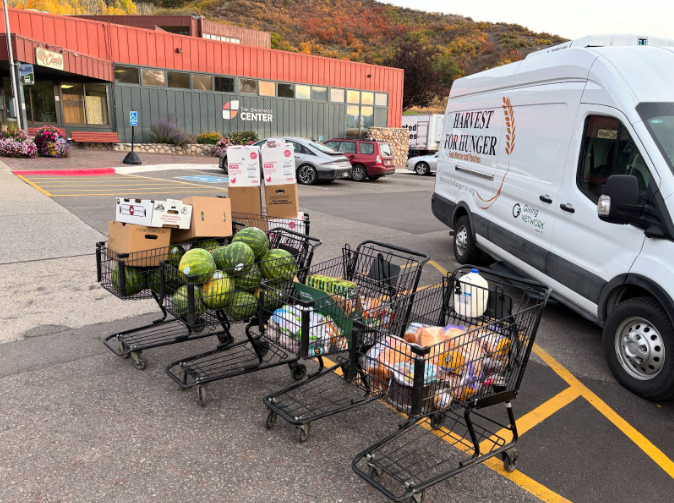
Another community organization that strives to help local families is Harvest for Hunger, founded by Gray Warr. Warr operates stigma-free pantries in Aspen, Snowmass, and Basalt, providing food to anyone who needs it. Unlike many other programs, it does not require families to disclose their name or their circumstances, providing a safe space for people to obtain food without judgment.
“Harvest for Hunger is a food rescue organization that partners with local organizations in the valley, like Paradise, Starbucks, and City Market, to get food,” Warr said. “We then stock the pantry, and anyone in the valley who needs food can come in and take what they need.”
The pantries are open 8 a.m. to 5 p.m., Monday to Friday. They are stocked with meat, produce, dairy, and pantry staples like canned goods, pasta, beans, and rice. As food needs have grown recently, the pantries have seen a record number of visits, serving approximately 550 people per week in Aspen and 50-70 people per week in Snowmass.