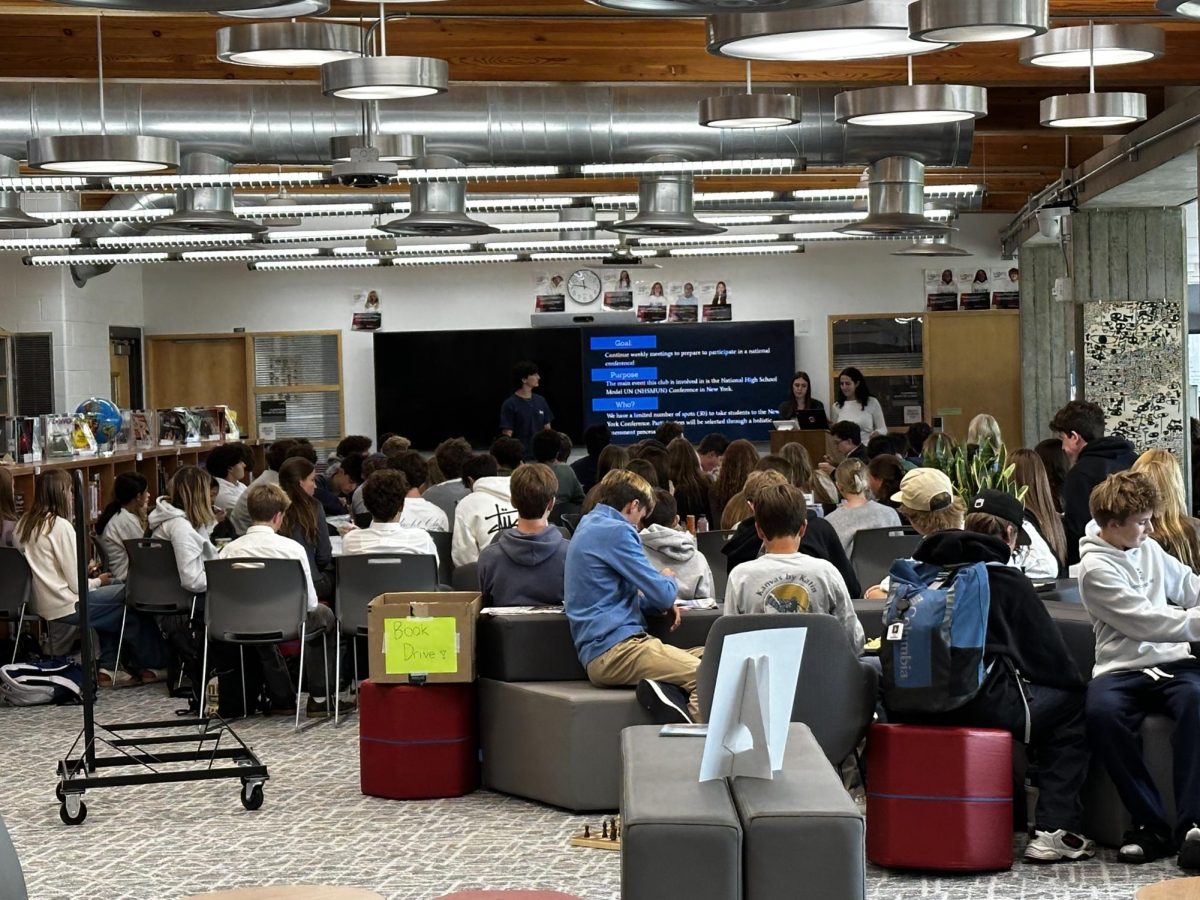













In a wide-ranging press conference with journalism students on October 30th, AHS admins and law enforcement officers discussed how they address internal and external threats to school safety. The discussion covered everything from anonymous Safe2Tell reports to lockdown drills, reflecting attention to school security even as officials noted that the overall number of school shootings has declined in recent years.
Responding to a student’s opening question about the rise in school shootings, Gregory Brannon (New Safety Director) emphasized that while media coverage can make incidents appear more frequent, data shows a decrease compared to the late 2010s.
“There was a higher level back then, but there’s actually been a decline,” the admin said. “Because it comes out on the news and it’s focused on, it seems like there’s a higher level, but there is a decline.”
Still, administrators acknowledged that the perception of risk remains strong and that schools must prepare for both outside threats and potential dangers from within.
School Resource Officers (SROs) described their role as extending beyond visible security. They emphasized the importance of early intervention and the use of “threat assessments” to identify red flags in student behavior before they escalate.
“We’re not just waiting for something to happen,” Officer Dru Lucchesi explained. “We’re trying to intervene on what’s called a pathway to violence with the student.”
Administrators stressed that visibility and connection are central to prevention. Teachers and SROs are encouraged to be in school hallways during passing periods, both to monitor activity and to foster relationships with students.
“When students know that the adults in the building care about them, they care about the surroundings of the school, and they really want to connect with the students, that is our very first line of defense,” one administrator said.
Students raised questions about the Safe2Tell program, which allows anonymous reporting of potential threats. Officials confirmed that reports are legally protected as anonymous, except in rare cases where false allegations are made with the intent to cause harm. In those instances, court processes can be used to identify the source.
“Other than that, it is anonymous by law and it’s protected by law,” said Nina.
Officials added that while some reports may contain inaccuracies, most include at least some valid concerns. “It’s very rare to have one that is completely false,” one speaker said. “There’s typically something, an aspect of it, to which we’re so grateful that we got that report.”
While schools do not work directly with the Secret Service on routine matters, officials said they have access to a wide network of resources, including state bureaus of investigation and analysts. They also share information about statewide trends, such as swatting calls, to stay ahead of potential threats.
“We have ways to track and dig into digital profiles,” one officer said, though details were not disclosed. “But again, we rely on you to give us that first alert.”
The conversation also touched on drug and alcohol use among students. Officials explained that cases involving minors in possession are handled jointly by schools and law enforcement, with additional support from community organizations.
“In Colorado and here in Pitkin County, we have this oversight group for juveniles that takes all the social services — the justice system, the schools, mental health, nonprofits,” one administrator said. “They talk once a month. We utilize that group to help support juveniles and families if they’re going through something.”
Students asked about safety during chaotic times, such as lunch or passing periods. Officials acknowledged the difficulty of accounting for everyone immediately but emphasized that safety takes priority over attendance.
“I tell the teachers, I need them to keep kids safe and then give accountability,” one official said. “The accountability is secondary. We’ll get to it.”
They advised students to use situational awareness in emergencies, deciding whether to shelter behind a locked door or exit the building. “If you hear the shooting inside, it’s not safe to stay here if you can’t get behind a locked door. Find a way to get out safely,” an officer said.
Officials also noted that while most school shootings involve a single perpetrator, vigilance remains essential. “Statistically, it’s a very low percentage that there are two shooters,” one officer said. “Usually it’s one, usually male.”
Administrators urged students to report unusual behavior or vehicles around campus. “If it feels weird, if it looks off, if it’s not quite what the culture feels like, it’s okay to report it,” one official said. “That’s what our jobs are… to keep us safe on our campus.”
They cited past incidents in other schools where suspicious cars were noticed but not reported until after the fact. “Someone saw it and didn’t say something,” the official said. “If we look at those data and actually watch the tape, those cars were coming in at weird times of the day.”
The press conference concluded with a discussion of lockdown drills. Some students expressed concern that peers do not take drills seriously, while others worried about confusion between drills and real events.
Officials said the solution is to treat every drill as if it were real. “We can only train you to always take it as a real thing,” one administrator said. “Please do take them seriously and encourage your peers. We rely on you all to encourage your friends.”
Schools conduct at least two lockdown drills per year, in addition to other safety exercises. Officials said they aim to strike a balance between preparedness and sensitivity, avoiding unnecessary trauma while ensuring readiness.
Officials reminded students that while school safety is a priority, most mass casualty events occur outside of schools. “Approximately 25 percent happen in schools, 75 percent happen out of school,” Nina said. “So just be aware wherever you are.”
The message throughout the session was that safety depends on a combination of professional vigilance, student awareness, and community cooperation.
“It’s a community kind of thing for all of us to be involved with the school of safety,” one administrator said. “It’s not just us or one person. It’s all of us who want to take responsibility for that.”